Products mentioned in this guide
Start here if you already know what problem you want to solve. These text-only cards use tagged Amazon links and do not reproduce Amazon product images or prices. Review the fit notes, then verify the current listing on Amazon.
Listing checked · Aug 14, 2026
Yamazaki Home Magnetic Spice Storage Rack Organizer for Fridge
Yamazaki Home · Japan-Designed
Turns an unused magnetic side panel into reachable storage without drilling.
- Why consider it
- A powder-coated steel shelf mounts with a magnet and is listed to hold up to 3.3 pounds.
- Best for
- Small kitchens with a genuinely magnetic refrigerator side or other flat steel surface.
- Check first
- Test the exact surface with a household magnet, measure 9.65 × 4.33 × 3.35 inches, and keep breakable or overweight items off the rack.
- Origin
- Japan-Designed; manufacturing country is unverified.
- At last check
- Ships from Amazon · Sold by Yamazaki Home
Paid Amazon link. Price, availability, seller, shipping party, and product details can change. Verify the current listing before ordering.
Magnetic-looking is not magnetic
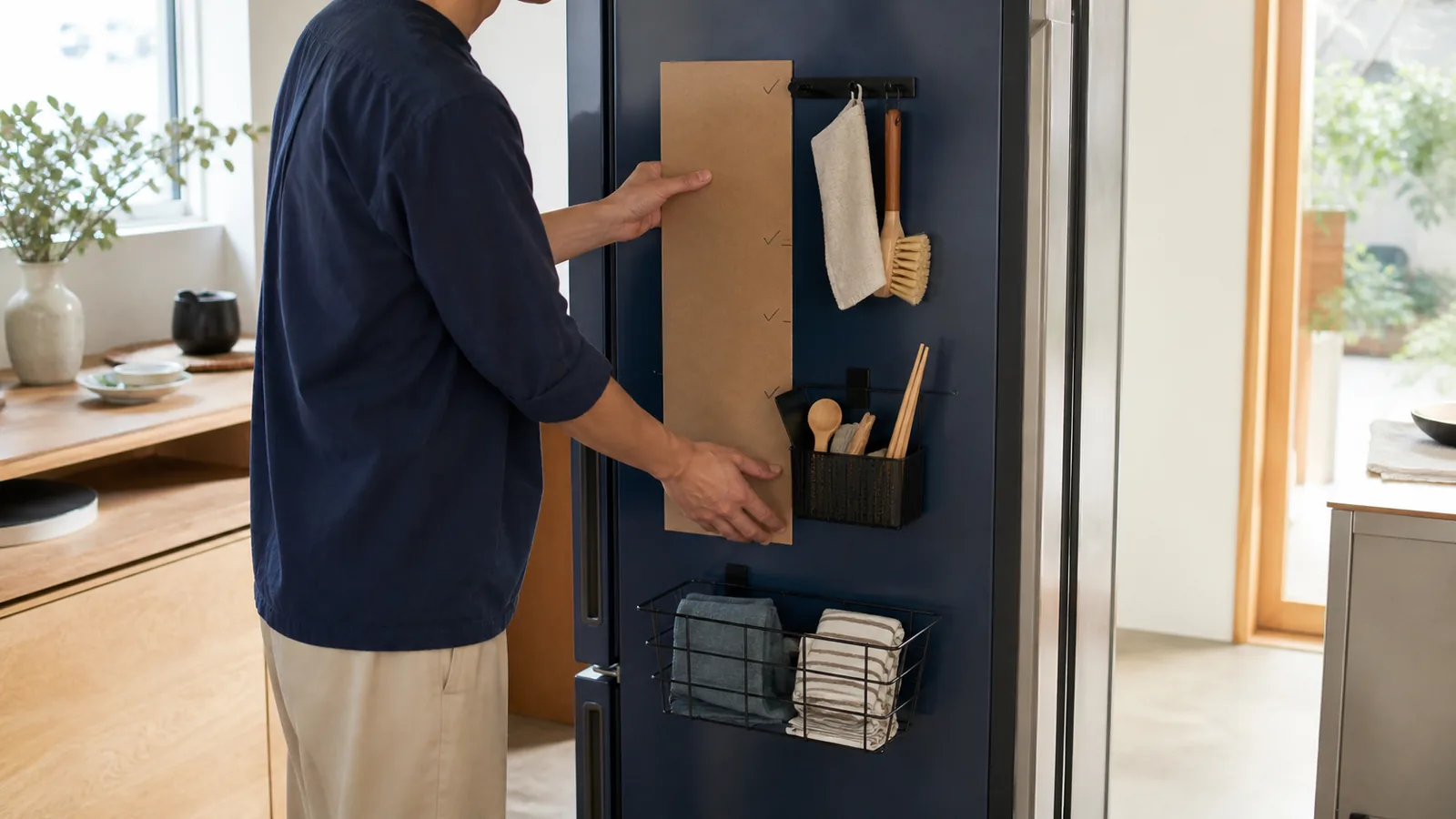
Stainless-looking refrigerator doors, decorative panels, and appliance sides can have different structures. A magnet may stick strongly to one panel and weakly—or not at all—to the next. Test the exact spot, not a similar finish elsewhere.
Run a three-part surface test
Use an ordinary household magnet to test attachment, then slide it gently to detect a weak or coated surface. Finally, inspect the panel for curvature, seams, vents, and flexible skin that could reduce full contact.
Do not mount over warning labels, ventilation, control panels, or a surface that becomes hot. Renters should also check whether repeated movement could mark a finish.
Measure width, projection, and movement
Record the rack width and how far it projects into the room. Open the refrigerator and nearby cabinets fully. Walk the normal route while holding a cardboard mock-up at the proposed depth.
Measure the tallest container, but also the hand clearance needed to lift it out. A rack that technically fits may still be awkward under an upper cabinet.
Calculate the real loaded weight
Add the weight of every full jar or bottle, not the empty packaging. Stay comfortably below the stated limit and place heavier items low and near the mounting surface. Do not use a kitchen rack for glass objects that could cause injury if the magnet slips.
Why magnetic storage fails
Most failures are predictable.
- Testing a different panel than the installation spot.
- Ignoring the weight of full containers.
- Blocking a door swing, handle, or vent.
- Choosing a basket too shallow for tall bottles.
- Pulling containers outward in a way that levers the rack off the surface.
Magnetic-storage checklist
Confirm each item with the actual location.
- Strong attachment across the full magnet area.
- Flat, cool, clean, dry surface.
- Loaded weight below the limit.
- Clear door swing and walkway.
- Enough hand clearance for removal.
- No fragile items where a fall could cause harm.
Fit is more than width
Good magnetic storage feels stable during the whole routine: opening the appliance, reaching for an item, replacing it, and cleaning around the rack. Test those movements before ordering.
How we choose what to consider
Criterion 1
The exact surface passes a magnet test.
Criterion 2
The loaded weight remains below the stated limit.
Criterion 3
The rack clears doors, handles, controls, heat, and traffic.
Criterion 4
Frequently used contents can be removed without pulling the rack.
Who this is for—and what to watch
Good fit for
- Renters avoiding drilling
- Small kitchens with verified steel panels
- Frequently used lightweight supplies
Watch for
- Stainless-look nonmagnetic panels
- Full-container weight
- Blocked ventilation or controls
Related guides
 Kitchen
 How to Evaluate Japanese Kitchen Tools Before Buying Online
A verification-first guide to dimensions, materials, care, origin claims, and seller details for US kitchens.
Read the guide Storage
 8 Japanese Storage Ideas for Small Apartments
Use routines, gaps, and vertical surfaces carefully—plus two verified, image-free product examples with honest fit checks.
Read the guide Cleaning
 How to Choose Japanese Cleaning Tools for Different Surfaces
Choose by surface, soil, stiffness, and care—not by novelty or an unsupported “scratch-free” promise.
Read the guide