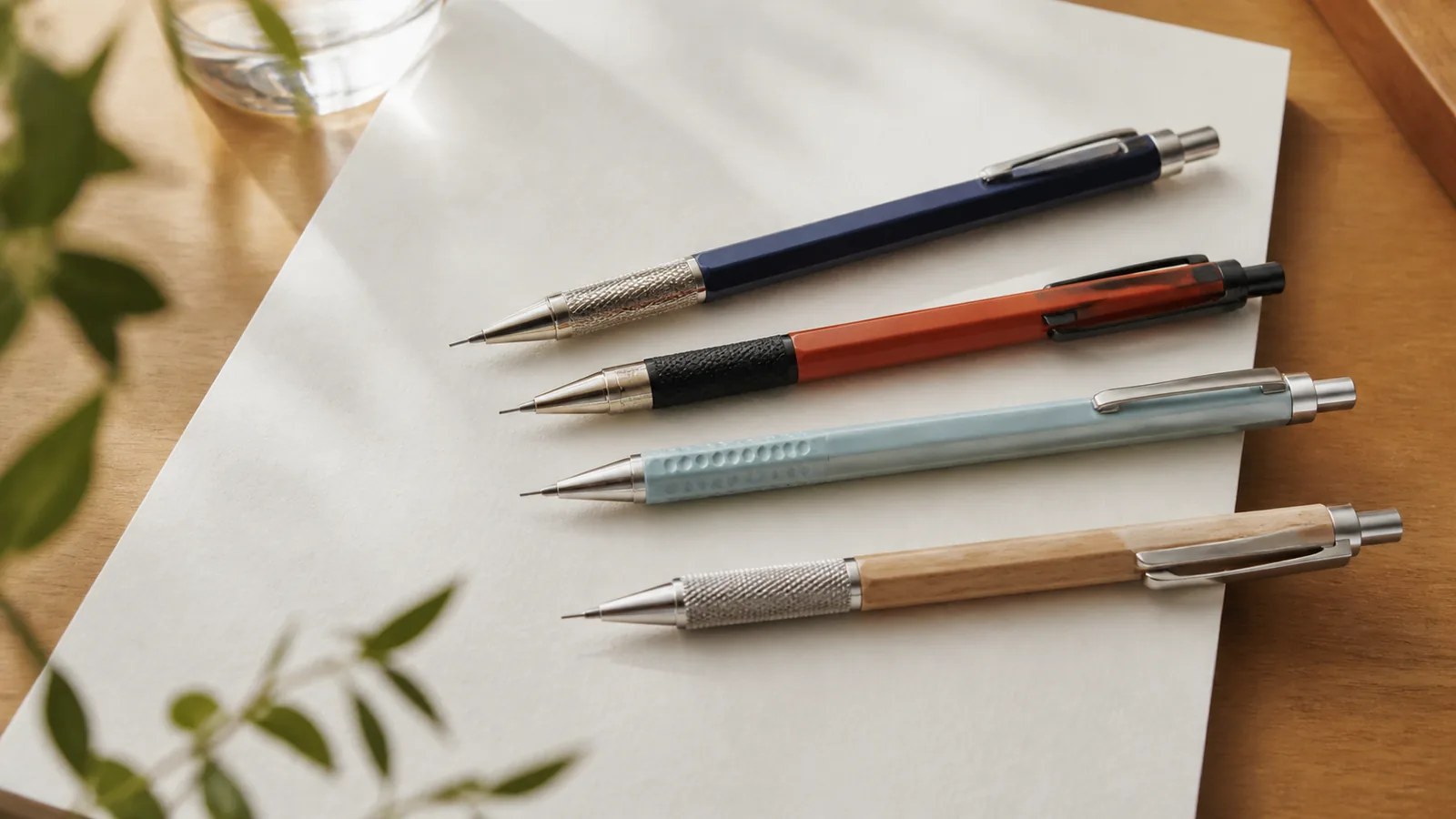
Quick picks
Best Overall
uniball Kuru Toga Elite Mechanical Pencil Kit, 0.5mm, HB, Silver, 1 Pack
The rotating lead mechanism keeps everyday handwriting more consistent.
View colors and lead sizes on AmazonBest Budget
Tombow Mono Graph Shaker Mechanical Pencil 0.5mm, Pattern Body (SH-MG)
Shaker advance and a twist-out eraser add useful features at a modest current price.
See current options on AmazonBest for Students
Zebra DelGuard 0.5mm Lead Mechanical Pencil, White Body (P-MA85-W)
The double-spring system is designed to reduce common lead breaks during fast notes.
Check availability on AmazonCompare all seven pencils
All seven products were available to New York, NY 10001 and displayed under $20 when checked on September 19, 2026. Prices, sellers, and stock can change at any time.
| Product | Best For | Lead Size | Main Feature | Details |
|---|---|---|---|---|
| uniball Kuru Toga Elite Mechanical Pencil Kit, 0.5mm, HB, Silver, 1 Pack | Everyday writing | 0.5 mm | Rotating lead mechanism | Read details |
| Tombow Mono Graph Shaker Mechanical Pencil 0.5mm, Pattern Body (SH-MG) | Budget pick | 0.5 mm | Shake-to-advance lead | Read details |
| Pentel GraphGear 1000 Mechanical Pencil, 0.5mm, Black Barrel (PG1015A) | Drafting and diagrams | 0.5 mm | Retractable 4 mm drafting tip | Read details |
| Zebra DelGuard 0.5mm Lead Mechanical Pencil, White Body (P-MA85-W) | Students | 0.5 mm | Double-spring lead protection | Read details |
| Pilot Dr. Grip G-Spec Shaker Mechanical Pencil, 0.5mm, Black Flash (HDGS-60R-FB) | Cushioned grip | 0.5 mm | Wide double-layer grip | Read details |
| Uni Alpha-Gel Mechanical Pencil 0.5mm, White (M5807GG1P.1) | Soft-grip writing | 0.5 mm | Shock-absorbing gel grip | Read details |
| Pentel Mechanical Pencil, Orenz, 0.5mm, White (XPP505-W) | Small handwriting | 0.5 mm | Sliding lead-protection sleeve | Read details |
The seven picks, in detail
We did not hands-on test these pencils. The summaries below use the current Amazon listing and manufacturer information, with absolute performance claims deliberately avoided.
Everyday writing
uniball Kuru Toga Elite Mechanical Pencil Kit, 0.5mm, HB, Silver, 1 Pack
Uni / uniball · 0.5 mm · ASIN B089QC2C8G
A rotating internal mechanism turns the lead gradually during ordinary writing to reduce one-sided wear.
Recommended for: Students and note-takers who prefer a fine, more consistent line and a knurled grip.
Pros
- More consistent line width as the lead wears
- Knurled grip adds control
- Refillable lead and replaceable eraser
What to know
- The kit sat at the top of this guide’s under-$20 range when checked.
- The metal-accented grip may feel heavier than a basic plastic pencil.
Amazon.com offer checked for New York, NY 10001 on . Ships from Amazon; sold by Amazon.com. Recheck the live offer before ordering.
View colors and lead sizes on AmazonBudget pick
Tombow Mono Graph Shaker Mechanical Pencil 0.5mm, Pattern Body (SH-MG)
Tombow · 0.5 mm · ASIN B00JAYRKT6
Shake the barrel to advance lead, or use the clip mechanism; a twist-out MONO eraser is built into the top.
Recommended for: Students and quick note-takers who want a light everyday pencil with a larger eraser.
Pros
- Low displayed price when verified
- Two practical lead-advance methods
- Twist-out eraser is larger than many pencil-cap erasers
What to know
- The active offer was from a third-party seller.
- A shaker mechanism adds movement and a little sound.
Amazon.com offer checked for New York, NY 10001 on . Ships from Amazon; sold by PureFamily. Recheck the live offer before ordering.
See current options on AmazonDrafting and diagrams
Pentel GraphGear 1000 Mechanical Pencil, 0.5mm, Black Barrel (PG1015A)
Pentel · 0.5 mm · ASIN B000GAU2RU
A retractable 4 mm sleeve, lead-hardness indicator, and textured metal grip make this the most drafting-focused option here.
Recommended for: Drafting, diagrams, rulers, templates, and writers who prefer a lower, more substantial grip.
Pros
- Retractable tip protects pockets and cases
- Long sleeve works well against rulers
- Lead-hardness indicator helps track refills
What to know
- The metal grip and drafting balance can feel substantial for long casual notes.
- The active offer was from a third-party seller.
Amazon.com offer checked for New York, NY 10001 on . Ships from Amazon; sold by TheWriteExpression. Recheck the live offer before ordering.
See current options on AmazonStudents
Zebra DelGuard 0.5mm Lead Mechanical Pencil, White Body (P-MA85-W)
Zebra · 0.5 mm · ASIN B00NN3YYXU
Its spring system responds to both vertical and angled pressure to help protect fine lead during fast writing.
Recommended for: Students, fast note-takers, and writers who tend to press firmly.
Pros
- Designed to reduce common lead breaks
- Textured grip improves control
- Standard 0.5 mm lead is easy to source
What to know
- Lead can still break if too much is extended or the pencil is misused.
- The verified offer had limited stock and a third-party seller.
Amazon.com offer checked for New York, NY 10001 on . Ships from Amazon; sold by Neo field of Japan. Recheck the live offer before ordering.
Check availability on AmazonCushioned grip
Pilot Dr. Grip G-Spec Shaker Mechanical Pencil, 0.5mm, Black Flash (HDGS-60R-FB)
Pilot · 0.5 mm · ASIN B003T9OZY6
A wide double-layer grip, centered weight distribution, and shaker advance distinguish it from slim everyday pencils.
Recommended for: Longer notes and writers who prefer a wide, cushioned grip.
Pros
- Wide cushioned grip
- Shake-to-advance option
- Balanced around the center of gravity
What to know
- The barrel may be too wide for small hands or narrow pen loops.
- The verified offer had limited stock and a third-party seller.
Amazon.com offer checked for New York, NY 10001 on . Ships from Amazon; sold by INTER SERV.. Recheck the live offer before ordering.
View colors and lead sizes on AmazonSoft-grip writing
Uni Alpha-Gel Mechanical Pencil 0.5mm, White (M5807GG1P.1)
Uni / Mitsubishi Pencil · 0.5 mm · ASIN B001BYJVNQ
Its soft Alpha Gel grip and low center of gravity suit shoppers who find hard, narrow grips uncomfortable.
Recommended for: Writers who prioritize a soft grip over a metal or textured grip.
Pros
- Soft cushioned grip
- Slim body despite the grip material
- Low center of gravity supports controlled writing
What to know
- The soft grip can collect lint or dust and will not suit everyone.
- The verified offer had limited stock and a third-party seller.
Amazon.com offer checked for New York, NY 10001 on . Ships from Amazon; sold by GJG audio USA. Recheck the live offer before ordering.
View colors and lead sizes on AmazonSmall handwriting
Pentel Mechanical Pencil, Orenz, 0.5mm, White (XPP505-W)
Pentel · 0.5 mm · ASIN B07KCLN42W
A sliding sleeve protects the lead as it wears, allowing a fine line with less exposed graphite.
Recommended for: Small handwriting and writers who want lead protection without a wide barrel.
Pros
- Lead-protection sleeve
- Fine 0.5 mm line
- Light everyday form rather than a heavy drafting grip
What to know
- The sleeve-on-paper writing feel takes some adjustment.
- The verified offer had limited stock and a third-party seller.
Amazon.com offer checked for New York, NY 10001 on . Ships from Amazon; sold by TF STORE. Recheck the live offer before ordering.
Check availability on AmazonHow to choose a Japanese mechanical pencil
Frequently asked questions
Which Japanese mechanical pencil is best for everyday writing?
The Uni Kuru Toga Elite is the most versatile choice here if you like a fine, consistent line. Its rotating mechanism addresses uneven lead wear, while the 0.5 mm size is widely available. Choose the Tombow MONO Graph instead if shaker advance and a larger eraser matter more.
Is Kuru Toga good for students?
It can be. The rotating lead system suits note-taking and small handwriting, but students who press hard may prefer the Zebra DelGuard because its mechanism is designed specifically to protect lead from vertical and angled pressure.
What lead size should I choose?
A 0.5 mm pencil is the safest starting point for most US shoppers because it balances a fine line with easy-to-find refills. Finer lead rewards light pressure and small writing; 0.7 mm or 0.9 mm is usually more forgiving for heavier pressure and broad notes.
Are Japanese mechanical pencils worth it?
They can be when a specific mechanism solves a problem you actually have. Rotating lead, shaker advance, retractable drafting tips, cushioned grips, and lead-protection sleeves are meaningful differences—not a guarantee that every model will fit every hand.
Shortlist
Three places to start
Choose Kuru Toga Elite for balanced everyday writing, MONO Graph for budget-friendly convenience, or DelGuard for a student-focused lead-protection design.
Related guides
 Kitchen
 How to Evaluate Japanese Kitchen Tools Before Buying Online
A verification-first guide to dimensions, materials, care, origin claims, and seller details for US kitchens.
Read the guide Storage
 8 Japanese Storage Ideas for Small Apartments
Use routines, gaps, and vertical surfaces carefully—plus two verified, image-free product examples with honest fit checks.
Read the guide Cleaning
 How to Choose Japanese Cleaning Tools for Different Surfaces
Choose by surface, soil, stiffness, and care—not by novelty or an unsupported “scratch-free” promise.
Read the guide